

The Technical Breakdown: Mastering the Mechanics of Mardi Gras Gold

Go to the Slots Oscars page to vote for Mardi Gras Gold
For the analytical player, the thrill of a slot machine isn't found in the flashing lights, but in the math, the mechanics, and the potential for mathematical variance. Mardi Gras Gold presents a compelling case study in modern slot engineering, utilizing a 6×6 cluster-pay architecture that departs significantly from traditional payline models.
In this deep-dive analysis, we will strip away the neon masks and the purple beads to examine the underlying engine that drives this high-volatility experience. If you are a player who prioritizes mechanics, cascading wins, and feature-heavy volatility, this technical overview is your roadmap to understanding Mardi Gras Gold.
Table of Contents
- Architecture: The 6×6 Cluster Engine
- Mathematical Advantage: Cascading Wins
- Feature Analysis: The Free Falls Cycle
- The Exploding Wild Variable
- Technical Specification Matrix
- Strategic Optimization
- Technical FAQ
- Summary

Architecture: The 6×6 Cluster Engine
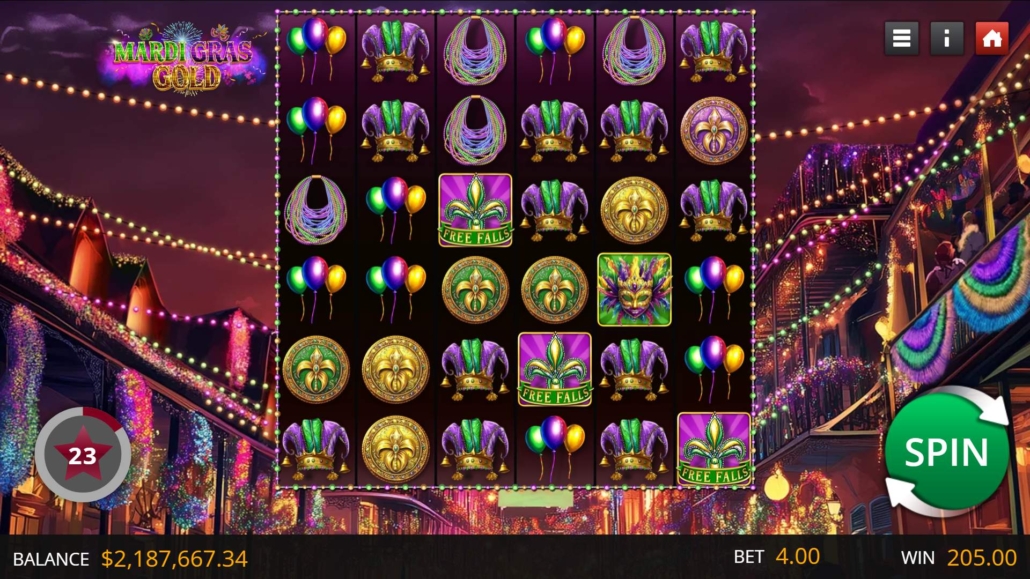
Mardi Gras Gold operates on a 6×6 grid, moving away from the standard 5×3 or 5×4 formats. The absence of fixed paylines is replaced by a Cluster Pays system. In this model, wins are determined by the number of contiguous identical symbols.
This architecture increases the "connectivity" of the game. Because symbols are evaluated by proximity rather than a linear path, the probability of forming high-value clusters is significantly altered, offering a more dynamic distribution of wins across the grid.

Mathematical Advantage: Cascading Wins
One of the most critical components of the Mardi Gras Gold engine is the cascading reel mechanic. When a winning cluster is identified:
- The winning symbols are removed from the grid.
- The remaining symbols shift downwards to fill the vacuum.
- New symbols enter from the top of the 6×6 grid.
This creates a "multi-win per spin" scenario. Mathematically, this allows the player to capitalize on a single wager through a series of consecutive wins, effectively increasing the realized RTP (Return to Player) during high-velocity sequences.
Feature Analysis: The Free Falls Cycle
The Free Falls feature is the primary driver of the game's high-end volatility. It is triggered by the Scatter symbol and operates on a tiered reward system:
- Tier 1 (3 Scatters): 8 Spins
- Tier 2 (4 Scatters): 14 Spins
- Tier 3 (5 Scatters): 20 Spins
Crucially, the feature includes a re-trigger mechanism. The ability to land additional Scatters during the bonus round allows for extended cycles of cascading wins, which is the most efficient way to approach the 17,680-coin maximum payout.

The Exploding Wild Variable
During the Free Falls mode, the game introduces a unique variable: the Exploding Wild. While a standard Wild facilitates cluster completion, the Exploding Wild acts as a "grid clear" mechanism.
Upon landing, the symbol removes between 3 and 8 surrounding symbols (excluding Scatters and high-pay symbols). From a strategic standpoint, the Exploding Wild serves to reset the grid state, forcing a cascade that can bypass "dead" areas of the board and bring in fresh symbols, thereby increasing the frequency of cluster formations.
Technical Specification Matrix
Core Statistics
- Grid Geometry: 6×6
- Win Logic: Cluster Pays
- Max Payout Ratio: 17,680x (Coins)
- Bonus Type: Re-triggerable Free Falls
Symbol Hierarchy & Functionality
| Symbol Type | Primary Function | Pay Method |
|---|---|---|
| Wild | Symbol Substitution | Cluster |
| Exploding Wild | Substitution + Grid Clearing | Cluster (Free Falls Only) |
| Scatter | Bonus Trigger / Payout | Total Wager Multiplier |
| High-Pay (Mask/Jester) | Value Accumulation | Cluster |
| Low-Pay (Doubloons) | Value Accumulation | Cluster |

Strategic Optimization
To optimize play within the Mardi Gras Gold framework, consider the following:
- Volatility Absorption: Given the high-volatility nature of the 6×6 cluster/exploding wild combo, players should utilize a bankroll that allows for extended sessions. The "peaks" (Free Falls) are significant, but the "valleys" (base game) can be deep.
- Cluster Concentration: In the base game, focus on the density of symbols. The center of a 6×6 grid offers the highest mathematical potential for cascading connections.
- Bonus Targeting: Because the Exploding Wild is locked to the Free Falls mode, the statistical "value" of the game is heavily weighted toward the bonus round.
Technical FAQ
Q: How does the Scatter payout differ from Cluster payouts?
A: Cluster payouts are calculated based on the specific symbols forming a group. Scatter payouts are calculated as a multiplier of the total credits wagered on the spin, making them more impactful to the overall bottom line.
Q: What is the maximum number of Free Falls possible?
A: While the initial trigger caps at 20, the re-trigger mechanic means there is no theoretical ceiling to the number of spins, provided Scatters continue to land.
Q: Does the Exploding Wild affect Scatter symbols?
A: No. The Exploding Wild is programmed to leave Scatter symbols intact, ensuring that bonus re-triggers are not accidentally destroyed by the explosion.
Q: Is the 6×6 grid larger than standard slots?
A: Yes. Standard slots are typically 5×3. The 6×6 grid increases the total number of symbol positions from 15 to 36, significantly increasing the complexity of the cluster math.
Q: How are wins paid?
A: All wins pay left-to-right (in a cluster sense), but Scatters pay "anywhere" on the grid.
Summary
Mardi Gras Gold is a sophisticated cluster-pay engine disguised as a festive parade. By combining a 6×6 grid, cascading mechanics, and the high-variance Exploding Wild, the game offers a mathematical profile that rewards players who can navigate its high-volatility cycles.
Analyze the patterns, master the cascades, and aim for the 17,680-coin peak.
[EXAMINE THE MATHEMATICS – PLAY NOW]