

The Math of Sweetness: A Technical Deep-Dive into Candy Clusters

Go to the Slots Oscars page to vote for Candy Clusters
For the analytical gambler, the allure of a slot machine isn't found in the bright colors or the whimsical sounds—it is found in the mechanics, the volatility, and the mathematical potential of the grid. Candy Clusters presents a fascinating study in modern slot engineering, utilizing a 6×6 Cluster Pays architecture that departs from traditional payline logic to offer a more dynamic, high-frequency win structure.
In this technical analysis, we will strip away the sugar coating to examine the underlying engine that drives this game’s 8,350x coin potential.
Table of Contents
- Engine Architecture: The 6×6 Cluster Framework
- Mathematical Mechanics: Cluster Logic & Multipliers
- The Feature Set: Volatility Drivers
- Technical Data & Statistical Overview
- Optimization Strategies for Analytical Players
- Data-Driven FAQ
- Summary of Mechanics

Engine Architecture: The 6×6 Cluster Framework
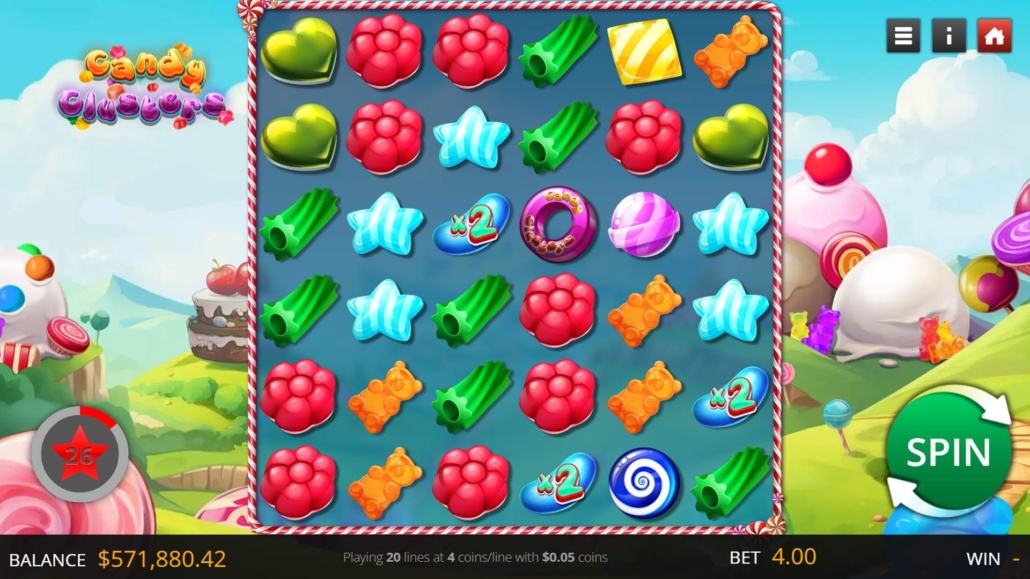
The core of Candy Clusters is its 6×6 grid. Traditional slots utilize fixed paylines (often 20 to 50 lines) which limit the ways symbols can interact. By moving to a 6×6 cluster format, the game shifts the focus to "area density."
The increased surface area of 36 individual cells allows for a significantly higher number of mathematical combinations. This layout facilitates the "Cascading Win" mechanic, where winning clusters are removed from the grid, allowing new symbols to descend. This creates a "re-spin" effect within a single paid round, effectively increasing the RTP (Return to Player) through chain reactions.

Mathematical Mechanics: Cluster Logic & Multipliers
Understanding the winning condition is vital for calculating your expected value (EV).
- The Adjacency Rule: A cluster is defined as 5 or more identical symbols that are connected horizontally or vertically. Diagonal connections are excluded, which maintains a structured mathematical difficulty for forming high-tier clusters.
- The Payout Formula: Wins are scaled based on the total credits wagered. Specifically, cluster wins are multiplied by 1/20 of the total credits wagered, providing a standardized way to scale rewards relative to stake.
- The Multiplier Variable: The Wild x2 symbol introduces a non-linear element to the payout math. By doubling any win in which it participates, the Wild acts as a volatility amplifier, allowing for sudden spikes in the payout curve.
The Feature Set: Volatility Drivers
The game's volatility is primarily driven by two features:
- The Wild x2 Substitute: Because the Wild can substitute for any symbol (excluding the Feature symbol), it serves as a mathematical "bridge," increasing the probability of completing 5-symbol clusters.
- Free Falls (Bonus Round): The trigger requirement of 4+ Free Fall symbols anywhere on the grid acts as the primary "High-Volatility Event." During this phase, the combination of the Wild x2 multiplier and the cascading clusters creates a compounding multiplier effect, which is the primary path to the 8,350x maximum win.

Technical Data & Statistical Overview
Statistical Summary
- Grid Dimension: 6×6 (36 Total Cells)
- Win Requirement: 5+ Adjoined Symbols (H/V only)
- Max Payout Ratio: 8,350x
- Multiplier Type: Fixed x2 (Wild-based)
- Feature Trigger: 4+ Scatter (Free Fall) Symbols
Symbol Hierarchy & Functionality
| Symbol Type | Functionality | Impact on Volatility |
|---|---|---|
| Free Fall | Trigger for Bonus Round | High (Primary Driver) |
| Wild x2 | Substitute + x2 Multiplier | Extreme (Multiplier Driver) |
| High-Tier (Diamond/Lozenge) | High Payout Clusters | High |
| Low-Tier (Jelly/Gummie) | Low Payout Clusters | Low (Base Frequency) |
Optimization Strategies for Analytical Players
To approach Candy Clusters with a professional mindset, consider the following:
- Volatility Assessment: Recognize that the 6×6 cluster model is prone to "clumped" wins. You may experience periods of low activity followed by intense cascading sequences.
- The Multiplier Synergy: The most efficient way to maximize EV is to land Wild x2 symbols during a cascade. The goal is not just to land a cluster, but to land a cluster that is expanded by a Wild.
- Bankroll Cushioning: Given the high-reward nature of the Free Falls feature, a bankroll should be partitioned to withstand the variance inherent in waiting for a 4-symbol scatter trigger.

Data-Driven FAQ
Q: What is the mathematical definition of a cluster?
A: A group of 5 or more identical symbols connected via horizontal or vertical adjacency.
Q: How does the Wild x2 affect the payout calculation?
A: It applies a 2x multiplier to the total value of any cluster win that includes the Wild symbol.
Q: How are wins calculated in relation to the wager?
A: Cluster wins are calculated as 1/20 of the total credits wagered per win event.
Q: Does the 6×6 grid change the frequency of wins compared to a 5×3 grid?
A: Yes, the 6×6 grid increases the number of possible symbol combinations and facilitates the cascading mechanic.
Q: Is the maximum win capped?
A: Yes, the maximum attainable payout is 8,350 Coins.
Summary of Mechanics
Candy Clusters is a sophisticated 6×6 cluster-pay slot that leverages cascading wins and a potent Wild x2 multiplier to drive high-volatility excitement. With a maximum win potential of 8,350x, it is engineered for players who value mathematical complexity and significant payout spikes.
Analyze the grid, master the clusters, and capitalize on the volatility. Play Candy Clusters now!